

Spread betting is the foundational pillar of modern sports wagering, designed to level the playing field between mismatched teams by applying a virtual point handicap. By forcing bettors to predict the margin of victory rather than just the outright winner, bookmakers create a highly dynamic and mathematically rigorous market. Whether you are analyzing complex football point spreads or engaging with the premier VN88 sportsbook, mastering these mechanics is essential for long-term profitability.”
Demystifying the point spread – The great equalizer
To understand how spread betting works, you must first understand the problem it solves. In sports, teams are rarely matched equally. If an elite, championship-caliber team plays a struggling team at the bottom of the league, simply betting on who will win (the moneyline) offers zero value; the favorite’s payout would be pennies, while the underdog’s risk is massive.
The bookmaker solves this by creating a “spread” or “handicap.” This is a predetermined number of points subtracted from the favorite and added to the underdog. The goal of the oddsmaker is not necessarily to predict the exact final score, but to set a number that is perfectly balanced, encouraging an equal amount of betting money on both sides of the ledger. By acting as the great equalizer, the point spread turns an uncompetitive blowout into a thrilling, 50/50 betting proposition.

Reading the lines: Favorites, underdogs, and the hook
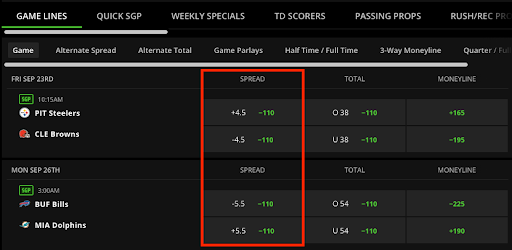
When you look at a sports betting board, the point spread is universally represented by plus (+) and minus (-) symbols. Decoding these numbers is the first step in executing your strategy.
Let us use an NFL football example: Team A is listed at -6.5, and Team B is listed at +6.5.
- The Favorite (-): Team A is the favorite. The minus sign indicates that 6.5 points will be subtracted from their final score. For a bet on Team A to win (known as “covering the spread”), they must win the actual game by 7 points or more.
- The Underdog (+): Team B is the underdog. The plus sign means they are given a 6.5-point head start. A bet on Team B wins if they win the game outright, tie the game, or lose by exactly 6 points or fewer.
You will frequently see point spreads featuring a half-point, such as 3.5 or 6.5. In the betting industry, this half-point is known as “the hook.” Because it is impossible to score half a point in mainstream sports, the hook guarantees a definitive outcome; there will be a clear winner and loser. If a spread is a whole number (e.g., -7) and the favorite wins by exactly 7 points, the bet is declared a “push,” and all original stakes are refunded to the bettors.
Understanding the vig and payouts
A common misconception among beginner bettors is that winning a point spread bet automatically doubles your money. In reality, bookmakers charge a transaction fee for brokering the wager. This fee is known as the “vigorish,” the “vig,” or the “juice.”
The standard odds attached to a point spread are -110 for both sides. The -110 figure means that you must risk $110 to win $100 in pure profit (returning your original $110 stake plus $100 winnings, totaling $210). This 10-cent difference is how the sportsbook makes its guaranteed profit regardless of the game’s outcome, provided they take equal action on both sides.
Because of the -110 juice, a sports bettor cannot merely win 50% of their spread bets to break even. To overcome the vig, a bettor must achieve a long-term win rate of exactly 52.38%. Everything above that percentage represents pure, sustainable profit.
Core strategies for conquering the point spread
Beating the spread consistently requires more than simply knowing which team has better players. Professional spread bettors treat the market like a stock exchange, analyzing data, public psychology, and timing.
Line shopping and timing the market
Point spreads are not static; they fluctuate from the moment they open until the game begins. If heavy public money pours in on the favorite, the bookmaker will move the spread (e.g., from -4 to -5.5) to entice bets on the underdog and balance their liability. A sharp bettor’s primary strategy is getting the best possible number.
Executing your carefully researched bets at the VN88 bookmaker ensures you can monitor these fluctuations and lock in your wagers at peak value before the line shifts unfavorably. Timing your bet to get a favorite early before the line inflates, or waiting to bet an underdog until the public pumps the line up, is a critical skill.
Identifying key numbers in sports
In sports like American football, scoring occurs in specific increments (3 points for a field goal, 7 points for a converted touchdown). Therefore, certain margins of victory are mathematically far more common than others. The numbers 3 and 7 are the most important “key numbers” in football spread betting.
Sharp bettors obsess over key numbers. There is a massive mathematical difference between betting a favorite at -2.5 versus -3.5. At -2.5, a late field goal by the favorite wins you the bet. At -3.5, that same field goal loses your bet. Understanding the historical frequency of these exact margins prevents you from making mathematically disastrous wagers.
Fading the public perception
The general betting public is notoriously biased. They love betting on high-scoring offenses, star quarterbacks, and massive favorites. They inherently dislike betting on ugly, defensive underdogs. Because bookmakers know this, they often artificially inflate the spread against popular teams. A highly profitable, albeit uncomfortable, strategy is “fading the public” – consistently betting on undervalued, unpopular underdogs that are receiving inflated points due to public bias rather than on-field reality.
The importance of disciplined bankroll management
The point spread is designed to be highly efficient, meaning no bettor will ever win 80% of their wagers over a long period. Even the most elite professional sports bettors in the world operate at a 54% to 56% win rate against the spread.
Because the margins are so razor-thin, bankroll management is the only thing that separates successful investors from bankrupt gamblers. Utilizing a flat staking model – wagering a strict 1% to 2% of your bankroll on every spread – will protect you from the inevitable variance and losing streaks that are baked into the mathematics of sports betting.
Conclusion
Spread betting transforms basic sports predictions into a mathematically rigorous exercise focused on team valuation and exact margins of victory. Success in this market demands a deep understanding of point valuations, market timing, and the discipline to exploit line movements against public sentiment. By applying these advanced analytical concepts and leveraging the VN88 app for your wagers, you can consistently navigate the point spread and achieve sustainable betting growth.