

Football bettors approaching roulette for the first time bring a mental model shaped by years of thinking about implied probability, expected value, and bookmaker margin. That analytical instinct is useful. But it also produces predictable mistakes when the game shifts from football (where information accumulates and skill creates edge) to roulette (where every spin is independent).
The core mental adjustment is understanding that roulette has no informational structure to exploit. In football betting, tracking form, injuries, tactical setups, and market movement genuinely creates edge over the closing line. None of that machinery applies on roulette, since the wheel does not care what happened on the previous spin.
This piece walks through what football-betting mental habits transfer usefully to roulette and what has to be consciously reset. It also covers the actual probability structure of the different roulette bet types, and the predictable mistakes football bettors make when their instincts run without adjustment.
How Football Betting Trains You for Probability Thinking
Football bettors already speak the language roulette runs on. Converting decimal odds to implied probability, working out the bookmaker’s overround, calculating expected value on a proposed stake, and thinking about variance across a session are all standard tools in the football bettor’s toolkit.
Roulette runs on exactly the same probability machinery, just with the numbers fixed and public. There is no closing line to beat, no bookmaker error to exploit, and no information advantage to build. The house edge sits at a mathematically precise 2.7 percent on European roulette (the wheel used in most UK and European casinos) and 5.26 percent on American roulette (with the extra double-zero pocket).
Interestingly, this fixed structure has attracted serious mathematical attention. the Small and Tse paper on roulette dynamics published in 2012 demonstrated that physical prediction of ball landing position could raise expected return from minus 2.7 percent to positive 18 percent under controlled conditions. That kind of edge is obviously not available to a mobile player, but it establishes what actually creates edge in this game: physics, not pattern-reading.
What Actually Changes When You Move to Roulette
Four things shift compared to football betting, and each requires a conscious mental adjustment.
First, skill edge disappears. In football, a bettor who correctly reads a team’s underlying form ahead of the market gains real edge. In roulette, no reading is possible, so no edge exists.
Second, spins are independent. In football, information about earlier matches (injuries, form, tactical shifts) informs betting on later matches. Each roulette spin is a completely independent event with no memory of prior outcomes.
Third, house edge is fixed and known. Football markets have variable overrounds ranging from around 102 percent on major games to 115 percent on niche markets. Roulette’s house edge sits at exactly 2.7 percent on every bet type on the European wheel.
Fourth, probability is perfectly known. Football probability estimation involves genuine uncertainty about which team will win, while roulette probability is mathematically exact. There is no estimation error and no market disagreement to exploit.
The Bet Type Categories and Their Probability Structure
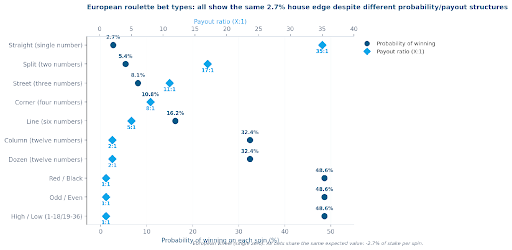
European roulette offers ten common bet type categories. The football bettor’s instinct is to think of them in terms of probability of winning, but the more useful frame is the probability-payout balance, since the two are inversely locked together by the wheel’s mathematical structure.
Playing Fruity King’s online roulette games or any other operator’s roulette product surfaces exactly the same ten bet categories, since they all sit on the same underlying wheel structure. The categories break down into six inside-bet types (individual numbers or small groups) and four outside-bet types (larger groups):
- Straight (single number). 2.7 percent probability, pays 35 to 1. The most extreme risk-reward ratio available.
- Split and Street (two or three numbers). 5.4 percent and 8.1 percent probability, paying 17 to 1 and 11 to 1 respectively.
- Corner and Line (four or six numbers). 10.8 percent and 16.2 percent probability, paying 8 to 1 and 5 to 1.
- Column and Dozen bets (twelve numbers). 32.4 percent probability each, paying 2 to 1. The middle ground between inside and outside bets.
- Red/Black and Odd/Even (eighteen numbers). 48.6 percent probability, paying 1 to 1. Not a coin flip, since the zero pocket keeps them below 50 percent.
- High/Low (1-18 or 19-36). Same 48.6 percent probability and 1 to 1 payout as Red/Black. Mathematically equivalent bet from a different angle.
The chart below shows the whole set at a glance. The inverse relationship between probability and payout is not accidental. It is engineered so that every bet type produces the same negative expected value.
The Equivalence Insight Every Football Bettor Needs to Grasp
The mathematically important fact about European roulette is that every bet type carries the same house edge of 2.7 percent per unit staked. A straight-up bet on a single number, a split, a corner, a dozen, and a red/black bet all produce identical expected losses over a large enough sample.
Football bettors often assume outside bets (red/black, odd/even) are safer or better value because they win more often. This intuition is wrong. Red/black wins nearly half the time but only pays even money, while straight-up numbers win rarely but pay 35 to 1, and the mathematics is designed so both produce the same 2.7 percent loss per unit staked over time.
The practical implication is that bet-type choice on roulette is a variance decision, not an edge decision. Outside bets deliver small frequent wins with low variance, while inside bets deliver rare large wins with high variance. Neither is mathematically superior; they just distribute the same expected loss across different session shapes.
How Football Bettors Actually Get Roulette Wrong
The transfer errors from football-betting instincts to roulette are predictable. ICRG research on sports bettors moving into casino play identifies the illusion of control as the primary transfer error. Sports bettors correctly perceive that their football knowledge creates edge over the market, then wrongly assume similar analytical effort creates edge on roulette.
Three other predictable mistakes follow from this misapplication of the football-betting mental model:
Reading patterns that are not there. A run of eight blacks in a row does not increase the probability of red on the next spin. Football bettors used to reading team momentum sometimes transfer that instinct incorrectly.
Assuming safer bets are better value. Red/black is not a safer path to profit than straight-up numbers. It is a lower-variance path to the same expected loss.
Chasing losses with progressive systems. Martingale-style doubling after losses feels like a valid recovery strategy to a football bettor familiar with staking systems, but produces guaranteed ruin at the table limit boundary because losing streaks of eight or more happen more often than most players model.
The genuine takeaway for a football bettor exploring roulette is that the analytical toolkit built for football (probability, EV, variance, staking discipline) transfers perfectly to understanding the mathematics of roulette. But the instinct that analysis can produce edge does not. Roulette rewards understanding of what it is, not any attempt to outsmart it.
Approached as entertainment with clear-eyed acceptance of the fixed house edge, roulette works fine. Approached as another game to analyse for edge, it drains bankrolls faster than a football bettor who is used to positive expected value on a small edge will initially believe.