

Before You Hit Aviator Login in Kenya: What the Game Actually Is and How to Play It Right
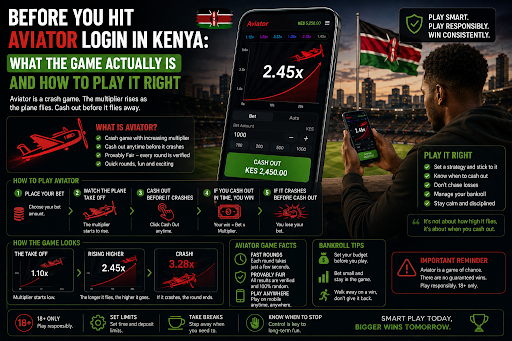
Aviator is the most searched casino game in Kenya, and a significant number of the people searching for it are looking for a login page without a clear picture of what they will find on the other side. That gap — between wanting to play and understanding what you are playing — is where most of the avoidable losses in Aviator happen. The Aviator login gets you into the game in thirty seconds. What you do in the first ten minutes after that, and whether you understand the mechanics before the first stake, matters considerably more than how fast you got in. This guide covers what Aviator actually is, what the numbers mean, how the cash-out decision works mathematically and what a sensible session looks like for a Kenyan player in 2026.
What Aviator actually is and what it is not
Aviator is a crash game developed by Spribe in 2019 where a virtual plane takes off with a rising multiplier and the player decides when to cash out before the plane flies away and the multiplier crashes to zero. The game has a certified RTP of 97%, meaning across millions of rounds it returns 97% of total wagered amounts to players. Each round lasts between ten and ninety seconds, stakes start from 10 KES on most Kenyan platforms and two simultaneous bets per round are available.
What Aviator is not is a skill game where experience or analysis improves the outcome. The crash point for each round is determined before the round begins by a provably fair random number generator using a server seed and a client seed, the combination of which produces a cryptographically verifiable result that no player or external tool can predict. This is not a weakness of the game — it is its defining property. Aviator is a game of pure chance with a single decision per round: when to exit. The RNG makes the outcome of that decision unpredictable in advance, and this is verifiable by any player who checks the round history.
The 97% RTP means that the house edge is 3%, which is low compared to most casino slots but still present and still compounding across every round. At 10 KES per round with rounds completing every thirty to sixty seconds, a one-hour session involves between 60 and 120 rounds. At 10 KES per round and 3% house edge, the expected cost of a one-hour session is between 18 and 36 KES in house margin alone, before any variance in either direction. Understanding this number before the first login changes how a session budget feels.
The cash-out decision: the only variable the player controls
The cash-out decision in Aviator is the single point of player agency in the entire game, and it is also the point where most losses that exceed the statistical expectation come from. The RNG determines when the plane flies away. The player determines when they exit. The interaction between these two produces the result.
There are two failure modes in cash-out decision-making that are common among Kenyan Aviator players. The first is exiting too early out of anxiety — cashing out at 1.2x every round because the plane has crashed at 1.1x twice recently. This feels safe but guarantees small returns that compound negatively over many rounds. The second is holding too long out of greed — watching the multiplier pass 3x, 5x, 8x and deciding to wait for 10x, only for the plane to crash at 9.2x. This feels like a near miss but is statistically no different from any other crash point.
Auto Cash Out, available in every licensed version of Aviator, sets a target multiplier before the round begins and exits automatically when that target is hit. This removes both failure modes simultaneously: the anxiety exit and the greed hold. A player who sets Auto Cash Out at 2x and never changes it will exit at exactly 2x whenever the plane reaches that point, which happens in approximately 47% of rounds based on the mathematical properties of the game’s RNG distribution. Over 100 rounds at 10 KES per round, this means roughly 47 wins of 10 KES profit and 53 losses of 10 KES, with the actual distribution varying significantly in short sessions due to variance.
Playing Aviator on a licensed platform in Kenya
CaptainsBet is among the licensed platforms carrying Aviator in Kenya, and the distinction between licensed and unlicensed matters specifically for Aviator because of the provably fair verification system. On a licensed platform, the round history is accessible after every game with the server seed hash, client seed and combined result available for independent verification using a SHA-512 calculator. This system makes it mathematically impossible for the platform to manipulate crash points without detection.
On an unlicensed platform claiming to offer Aviator, none of this verification is available or independently auditable. The game may look identical but the crash points are not subject to any certification or third-party audit. This is not a theoretical risk — cybersecurity research from the Communications Authority of Kenya has documented cases of games presented as Aviator with non-certified RNG implementations on unlicensed sites operating in the Kenyan market.
The practical check is simple: any licensed Aviator installation shows a verified badge and makes the round hash verifiable. If a platform’s Aviator does not offer hash verification in the round history, that is a signal worth taking seriously before depositing.
A sensible session structure for Kenyan Aviator players
| Session variable | Recommended approach | Why it matters |
| Session budget | Fixed amount decided before opening the game | Prevents reactive reloading after losses |
| Stake per round | 1% to 3% of session budget | Survives losing runs without exhausting balance |
| Auto Cash Out target | Set before each session, not changed mid-session | Removes anxiety and greed from the decision |
| Session time limit | Fixed number of rounds or time, not outcome-dependent | Prevents extended sessions driven by variance |
| M-Pesa top-up rule | Only before the session starts, not during | Prevents reactive depositing during losing runs |
The table captures five session variables that experienced Kenyan Aviator players manage consistently. The most important is the M-Pesa top-up rule: depositing additional funds during a losing run to chase recovery is the single behaviour most associated with sessions that end significantly over budget. M-Pesa’s speed — deposits in under ten seconds — is a feature that is also a risk in this context, because the friction that traditionally slowed reactive deposits has been removed. Setting a session budget before logging in and committing to it regardless of how the session goes is the structural habit that makes this speed a benefit rather than a liability.
On CaptainsBet, Aviator is available in demo mode before any real-money play, which is the right place to test Auto Cash Out at different target multipliers and develop a sense of how variance behaves across 50 to 100 rounds. A player who has watched 100 demo rounds at a 2x Auto Cash Out target has a realistic picture of how often that target is hit and how the balance moves across a typical session, which is more useful preparation than any strategy guide.
Conclusion
Aviator in Kenya is a provably fair crash game with 97% RTP, a single player decision per round and no skill component beyond cash-out discipline. The login is straightforward. What matters is the session structure around it: a fixed budget, a consistent Auto Cash Out target and an M-Pesa top-up rule that prevents reactive depositing during losing runs. Playing on a licensed platform with verifiable round history is the baseline that protects the game’s integrity. Everything else — which multiplier to target, how long to play — follows from understanding that the RNG makes every round independent and that no predictor or pattern can change that. Always bet responsibly and within your monthly budget.
FAQ
What is Aviator and how does it work in Kenya? Aviator is a crash game by Spribe with 97% RTP where a plane takes off with a rising multiplier and the player decides when to cash out before the plane flies away. The crash point for each round is determined before the round begins by a certified provably fair RNG, making each round statistically independent of all previous rounds. The game is available on licensed Kenyan platforms from 10 KES per round with demo mode available before real-money play.
What does the Auto Cash Out function do in Aviator? Auto Cash Out is a function that exits the player’s bet automatically when the multiplier reaches a pre-set target, removing the need for a manual decision during the round. Setting Auto Cash Out before each session at a consistent target multiplier eliminates the two most common decision failures in Aviator: exiting too early from anxiety and holding too long from greed. A target of 2x, for example, is hit in approximately 47% of rounds based on the game’s RNG distribution.
How do I play Aviator safely on a licensed platform in Kenya? Playing Aviator safely in Kenya requires using a licensed platform that provides provably fair round verification, where the server seed hash and client seed for each round are accessible after the result and verifiable independently using a SHA-512 calculator. Licensed platforms including CaptainsBet carry Aviator with this verification system active, which makes it mathematically impossible for the platform to manipulate crash points without detection.