
Whether you are a novice learning the mechanics or a seasoned punter executing complex statistical models through the professional FB88 platform, understanding what a handicap means is the foundational key to unlocking true market value.
The fundamental definition of a handicap in sports betting
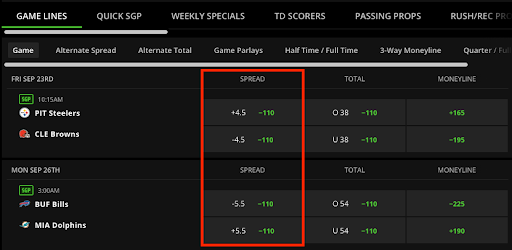
At its core, a handicap in betting is a numerical figure set by a bookmaker to counter the perceived difference in ability between two competing teams or athletes. In professional sports, true parity is incredibly rare; there is almost always a superior side (the favorite) and an inferior side (the underdog).
If bookmakers only offered traditional “match-winner” odds on a fixture like Manchester City playing a fourth-tier club in a cup competition, the odds on Manchester City would be so infinitesimally small that betting on them would yield virtually no return, while betting the underdog would be throwing money away.
To stimulate betting action on both sides, the oddsmaker assigns a virtual deficit to the favorite and a virtual advantage to the underdog before the event even begins. This advantage is measured in goals, points, sets, or games, depending on the sport. For your handicap bet to win, the team you select must cover this virtual spread when the handicap is applied to the actual final score of the match.
Decoding the mathematics: How handicap lines work
To truly grasp what a handicap means, you must understand how to mathematically apply the numbers to a real-world scenario. Let us use a standard football (soccer) match as an example, featuring Team A (the favorite) and Team B (the underdog).
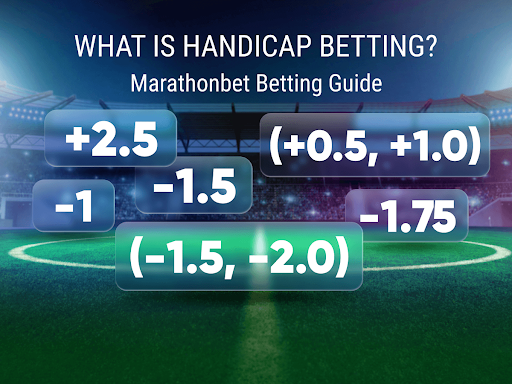
The bookmaker assigns a handicap of -1.5 to Team A and +1.5 to Team B.
- Betting the favorite (-1.5): If you place a wager on Team A with a -1.5 handicap, they start the match with a virtual score of minus 1.5 goals. For your bet to be successful, Team A must win the actual match by 2 goals or more (e.g., 2-0, 3-1, 4-0). If they only win by 1 goal (e.g., 1-0 or 2-1), or if they draw or lose, your bet is a loser.
- Betting the underdog (+1.5): If you back Team B with a +1.5 handicap, they begin the match with a 1.5-goal advantage. Your bet wins if Team B wins the match outright, if the match ends in a draw, or even if Team B loses by exactly 1 goal.
By introducing the “.5” fraction (the hook), the bookmaker mathematically eliminates the possibility of a draw in the handicap market, guaranteeing that one side of the bet will win and the other will lose.
European handicap vs. Asian handicap: The critical differences
As you dive deeper into handicap betting, you will encounter two primary variations: the European Handicap (EH) and the Asian Handicap (AH). Understanding the distinction between these two is vital for managing your risk.
The European handicap (3-way handicap)
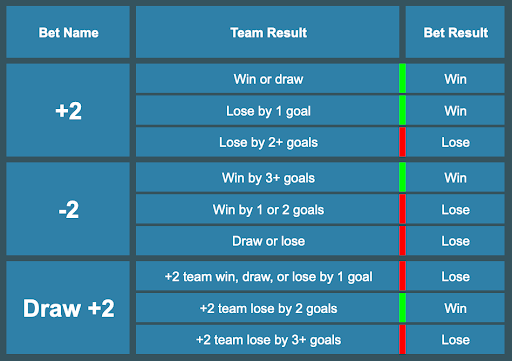
The European Handicap uses whole numbers (e.g., -1, -2, +1) and, most importantly, it retains the “draw” as a valid betting option. If you bet on a team at -1 in a European Handicap, and they win the match by exactly one goal (e.g., 1-0 or 2-1), the “handicap draw” is the winning outcome.
If you backed the team to win at -1, you lose your stake. Because there are three potential outcomes (Home Win, Draw, Away Win), the odds offered are generally higher, but the probability of winning is mathematically lower (33.3%).
The Asian handicap (2-way handicap)
The Asian Handicap is heavily favored by professional sports bettors because it completely eliminates the draw, turning the market into a two-way proposition (50% probability). It achieves this by using fractions like 0.5, or by offering “quarter-goal” lines (like -0.25 or +0.75) which split your stake across two different handicaps to provide bankroll protection. Furthermore, if an Asian Handicap uses a whole number (like -1.0) and the favorite wins by exactly one goal, the bet is declared a “push,” and your entire stake is refunded.
Advanced strategies for handicap betting
Knowing what a handicap means is just the theory; exploiting these lines requires rigorous statistical analysis and situational awareness. Professional bettors do not just guess; they analyze data to find discrepancies in the bookmaker’s numbers.
Identifying overvalued favorites
Public bettors love backing famous teams, which often causes the bookmaker to inflate the favorite’s handicap to balance their financial liability. A sharp bettor looks for situations where a heavy favorite (e.g., -2.5 goals) is facing a tightly organized, defensive opponent.
If the favorite has an upcoming Champions League fixture and is likely to rotate their squad or play conservatively after taking a 1-0 lead, the data suggests backing the underdog with the +2.5 handicap. Once you identify these statistical mismatches, completing your FB88 registration provides the high-speed betting environment needed to lock in premium handicap lines before the market reacts.
Analyzing situational motivation
Handicap betting heavily relies on team motivation. A mid-table team with nothing left to play for at the end of the season will rarely push hard to cover a massive -1.5 handicap against a team fighting desperately to avoid relegation. Understanding the psychological context of a match allows you to predict whether a team will push for a ruthless 4-0 victory or settle for a comfortable 1-0 win, directly influencing which side of the handicap holds true value.
Conclusion
Ultimately, understanding what a handicap means in betting empowers you to look past simple match-winner markets and uncover deep mathematical value in mismatched fixtures. Success requires rigorous statistical analysis, a clear comprehension of how virtual deficits affect the final payout, and uncompromising bankroll discipline. By applying these advanced principles and engaging in FB88 betting, you can elevate your sports betting strategy from recreational guessing to profitable investing.