

Walk into any sportsbook, online or off, and you will see three numbers next to almost every game: a spread, a moneyline, and a total. That third one is the over/under, and it might be the easiest bet in the building to understand on the surface. You just guess whether the combined score will land above or below a set number. Simple, right? Mostly. But there is more going on underneath than most casual bettors realize, and getting the details wrong is how a “sure thing” turns into a loss.
This guide breaks down what over and under actually mean, how sportsbooks land on a number, and how to place a smarter bet than the person next to you. We will also look at a real total from early 2026 to show how the math plays out in practice.
What Does Over/Under Actually Mean
An over/under bet, also called a totals bet, asks one question only: will the combined final score of both teams go above or below a number set by the sportsbook? It does not matter who wins. It does not matter by how much. A blowout and a nail biter can both hit the same total.
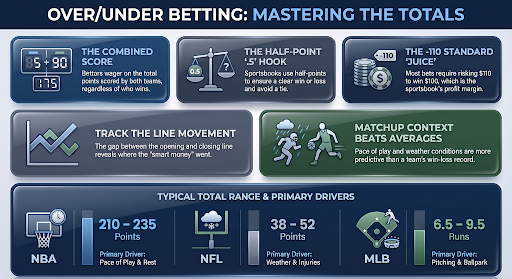
Say a basketball game has a total of 220.5 points. Bet the over, and you need the two teams to combine for 221 points or more. Bet the under, and you need 220 or fewer. That half point exists specifically so there is no tie, no “push,” no refund. Sportsbooks like clean outcomes, and a whole number total (say, 220 flat) can end in a push where both sides get their money back.
Here is a small paragraph that matters more than it looks: totals betting exists across nearly every sport with a scoreboard, from football and basketball to hockey, soccer, tennis games, and even esports. Wherever there is a number of points, runs, or goals, a bookmaker will set a line on it. And crypto sportsbooks have made this kind of quick, low friction wager more accessible than ever. BetFury, for instance, lets bettors wager on sports with Bitcoin across major leagues, which appeals to people who want fast deposits without routing money through a bank account first.
How Sportsbooks Set the Total
Oddsmakers do not pull totals out of thin air. They build a number from pace, injuries, weather, matchup history, and how each team has scored recently. Then the number gets tested against real money. If bettors pile onto one side too heavily, the book will move the total to balance action and protect its margin, known as the vig or juice.
That juice is usually baked in as -110 on both sides, meaning you risk $110 to win $100. Some totals carry different pricing, like -115 on the over and -105 on the under, when the book expects one side to draw more betting volume than the other. It is not evidence that one side is more likely to happen. It is just business.
A quick table helps show how the number moves once the market gets involved:
| Stage | What Happens |
| Opening line | Set by the book using models and early information |
| Public betting | Bettors react, money starts flowing to one side |
| Line movement | Book adjusts the total or the odds to balance risk |
| Closing line | The final number right before the game starts |
Sharp bettors often watch that gap between the opening and closing line. A total that opens at 47 and closes at 44.5 is telling you something, usually about weather, injury news, or where the smart money went.
Step by Step: How to Place an Over/Under Bet
Step 1: Find the Total on the Betting Board
Every game listing shows the total, usually labeled “O/U” or just “Total,” right next to the spread and moneyline.
Step 2: Decide Over or Under
This is where research matters. Look at pace of play, recent scoring trends, weather for outdoor sports, and who is missing from the lineup. Don’t just guess based on which team you like more.
Step 3: Check the Odds on Each Side
Totals are rarely priced exactly even. A five or ten cent difference between the over and under can change your expected return over time, even if your win rate stays the same.
Step 4: Place the Bet and Track It
Once placed, a totals bet is locked in at that number and price. Some sportsbooks allow live, in-game totals too, where the number adjusts as the action unfolds.
Real Example: Super Bowl LX Total
Numbers help more than theory, so here is one from this year. Super Bowl LX between the Seattle Seahawks and New England Patriots, played February 8, 2026, at Levi’s Stadium, carried a total near 45.5 points across most major books. FanDuel had the over priced at -115 and the under at -111, meaning the market saw the under as very slightly more likely to hit, at least by the odds.
A $10 bet on that over would have returned $8.70 in profit if it won. The under would have paid a touch more, around $9.01 on the same $10 stake. Small gaps, but they add up over a full season of bets.
Zoom out further and the history gets interesting. Heading into that game, Super Bowl totals had split almost perfectly, 29 overs against 29 unders across every Super Bowl that had a total set (the very first game never had one). The lowest total ever posted was 33, used four separate times. The highest sat at 57.5, back for the Patriots and Falcons matchup that ended 62 total points. So even at the highest level of the sport, with the sharpest oddsmakers in the world working the number, totals betting is close to a coin flip more often than people assume.
Over/Under Across Different Sports
The concept stays the same everywhere, but typical ranges shift a lot depending on the sport.
| Sport | Typical Total Range | What Drives It |
| NFL | 38 to 52 points | Pace, weather, injuries, defense rankings |
| NBA | 210 to 235 points | Pace of play, rest days, back to back games |
| MLB | 6.5 to 9.5 runs | Starting pitchers, ballpark, wind |
| Soccer | 1.5 to 3.5 goals | Attacking style, head to head history |
| NHL | 5.5 to 6.5 goals | Goaltending matchups, special teams |
Baseball and soccer totals sit on much smaller numbers, which means even one extra run or goal can flip the outcome. That makes them feel simpler on paper but genuinely harder to predict with confidence.
Pros and Cons of Betting Totals
Nothing in sports betting is free of tradeoffs, and totals are no exception.
Advantages:
- No need to pick a winner, which removes bias toward a favorite team
- Odds are usually close to even on both sides, keeping the vig lower than some prop bets
- Works the same way across almost every sport, so the learning curve is short
- Live totals let you react to how a game is actually playing out
Drawbacks:
- Overtime, extra innings, or shootouts can swing a total unpredictably
- Weather changes late in the day can shift a line without warning
- Backup or resting starters in blowouts sometimes tank scoring near the end
- Public bias toward overs (fans love scoring) can distort where the smart value actually is
Common Mistakes Bettors Make
Rookie bettors tend to fall into a few of the same traps. First, betting the over just because a game “feels exciting,” without checking pace or weather. Second, ignoring injury reports, since a missing quarterback or star scorer changes a total more than almost anything else. And third, chasing a total after it has already moved significantly, which usually means the value has already been taken by earlier bettors.
Should you always fade the public? Not necessarily. But when 80% of bets are on the over and the line has not moved much, that is often a sign the sportsbook likes taking that action, which tells you something.
There is also a subtler mistake, one that even experienced bettors make. They treat every total as if it exists on its own, forgetting that a total is really a prediction about how a specific matchup will unfold, not a general guess about “high scoring” or “low scoring” teams. A fast paced team facing a defense built to slow the game down does not just average out to a medium total. It often ends up lower than expected, because the slower team controls the clock and limits possessions. Matchup context beats season averages almost every time.
Tips for Betting Totals Smarter
Track pace stats, not just win-loss records. A team can be mediocre and still play at a fast tempo that pushes totals over. Compare the opening total to the current one before betting, since that gap tells you where the money has gone. Watch weather reports for outdoor games right up until kickoff, because wind and rain crush passing offenses fast.
One more thing worth doing: keep a simple log of your totals bets, separate from spread or moneyline picks. Patterns show up over fifty or a hundred bets that you would never notice after just five or ten.
Odds comparison sites and betting research outlets track this kind of movement in detail. SportsbookReview, for example, publishes closing line data and historical trends that can show you how often a total actually hits over versus under for a given sport or event, based on years of results rather than gut feeling (see their Super Bowl over/under breakdown for an example). The Lines, another research focused site, has a solid explainer on how totals work across different sports, including the math behind vig on both sides of a market. Reading a few of these before placing real money down tends to save people from the most common beginner errors.
Frequently Asked Questions
What happens if the total lands exactly on the number? If the total is a whole number and the final score matches it exactly, the bet is a push and stakes are returned. Half point totals exist specifically to avoid this.
Is over/under betting easier than picking spreads? Not really easier, just different. It removes the need to judge which team is better, but you still need to judge pace, weather, and matchup style.
Can totals change during a live game? Yes. Many books offer live totals that adjust in real time based on the score and time remaining, which is a separate bet from the pregame total.
Totals betting rewards patience more than instinct. The number looks simple on the board, but behind it sits a pile of data, weather reports, and injury news that shifted it into place. Learn to read that shift, and an over/under bet stops being a coin flip and starts being an actual decision.